
Garden cleanup after summer in Dubai usually starts with two problems: plants that look dead, and a pile of branches, leaves and palm fronds that keeps growing.
Local sources describe October to March as Dubai’s main planting season, so it pays to sort both now. But do not cut everything brown. Some plants will recover, and the pile needs somewhere allowed to go.
This guide shows you how to check what is really dead, clear the waste and prepare your beds for winter planting.

Spend 15 minutes walking the garden before you pick up any tools. Go section by section: lawn, hedges, shrubs, palms, pots and beds.
Look for three things:
Dry leaves, bare stems, and broken branches.
Did several plants in one row or one corner decline while plants nearby stayed healthy? A pattern points to a shared cause, not bad luck.
Piles of branches, fronds and cuttings, plus any non-plant items such as broken pots.
If you are unsure about a plant, tie a ribbon or tag to it. It marks the plant as “check again later” so nobody removes it by mistake. This is a practical tip rather than a rule, and it helps if a gardener or contractor also works in your garden.
A plant that died from heat is one problem. A plant that died because its dripper was blocked is another. If you replace it without fixing the dripper, you will probably lose the new plant too.
Irrigation maker Rain Bird notes that blocked, clogged or leaky drippers and tubing can leave some plants overwatered and others too dry. It also notes that roots and insects can get into drip tubing and disrupt the flow. So before you clear anything:
Two safety notes. Do not dig near buried pipes or electrical fittings until you know where they run. And if you find a fault you cannot identify, ask a qualified maintenance professional. In a managed community, report irrigation faults to whoever looks after the landscaping.
If the same bed keeps failing even when the irrigation works, the cause could be the soil or the water. Do not guess from one symptom. Ask a local horticultural professional to look at it.
Brown leaves do not prove a plant is dead, and no single check is perfect. The tests below are useful clues. They work best when you use several together and look at more than one stem.
The scratch test is designed for woody plants such as shrubs and trees. It may tell you little about palms, succulents or soft-stemmed plants, so treat those differently.
Keep your tools clean.
Clean your blade or pruners between plants. Plant diseases can spread on tools, even during a scratch test.
| What you find | What it may mean | What to do |
|---|---|---|
| Green under the bark, but few or no leaves | Probably alive but stressed | Leave it. Watch for new buds and trim later. |
| Top is dead, new shoots at the base | Likely recovering from the roots | Cut dead stems back to just above living growth. |
| Brittle stems, brown inside | Those stems are probably dead | Cut back to green wood, or to the base if all stems are dead. |
| Brown under the bark all the way down, dark or soft roots, and no new growth after a wait | Probably dead | Remove it, roots included, once you know where the pipes are. |
| Spent seasonal flowers that pull out easily | Finished | Pull and discard, or compost if healthy. |
If the results are mixed or unclear, do not remove the plant yet. Mark it, give it more time, and ask your gardener or a nursery to take a look.
The RHS says plants that still have green under the bark or a firm rootstock can be left for a few months to see if they improve. That advice comes from the UK. No Dubai guide we could find gives a fixed waiting time, so give doubtful plants some cooler weeks, watch for fresh buds, and ask your gardener or a nursery about specific plants.
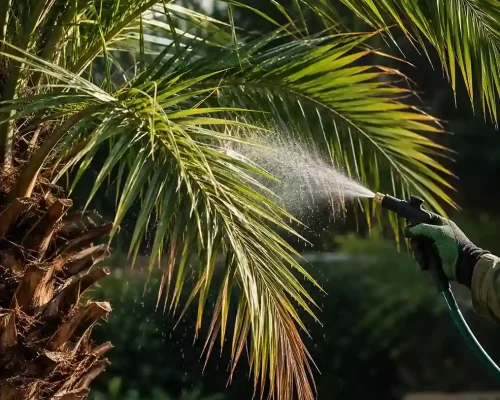
Palms need a gentler approach than ordinary shrubs. Fresh cuts on a palm can matter because of the red palm weevil, a pest that affects date palms and other palm species in the UAE. International agricultural guidance reports that the weevil is attracted to fresh wounds on palms. How much extra risk this adds for a garden palm in Dubai depends on the palm and the situation, and we did not find Dubai-specific pruning rules.
A careful approach:
Palm fronds are also long and bulky, so plan space for them.
A mixed pile is harder to move, harder to describe and harder to quote. Sort it first:
Material | Why keep it separate | Next step |
Leaves, grass and soft cuttings | Light and easy to handle | Compost if you have a bin and space, or bag for collection. |
Diseased or pest-affected plants | Can spread problems | Do not compost. Bag separately. |
Palm fronds and thick branches | Bulky and awkward | Keep clear of walkways. Separate very large pieces. |
Roots, turf, soil, sand and stones | Much heavier than green waste | Keep apart from leaves and mention them when booking. |
Broken pots, plastic, hose and timber | Not green waste | Separate them and mention them when booking. |
Keep sharp or thorny cuttings away from paths. Before you book a collection, take photos of the pile from two angles. Photos help a collection team understand a large or awkward load.
Start with who is responsible:
Some include taking the waste away. Many do not. Check the wording before you pay for a second service.
Some communities allow small, neatly bundled amounts in the household bin. Large piles of branches and fronds usually do not fit that rule. Ask your community manager.
Responsibility can depend on your tenancy contract and community rules, so confirm it before you arrange anything.
Then avoid the mistakes that can cost money. Please treat the points below as a guide, and check the current rules with Dubai Municipality or your community if you are unsure:
A Khaleej Times report in August 2026 on Dubai's public cleanliness resolution lists a Dh1,000 fine for disposing of waste in public places, in vacant lots, or in places other than those designated for disposal. The report describes waste in general. It does not single out garden waste, so the exact penalty in a given case can depend on the situation.
A Gulf News summary of Dubai's penalty schedule lists open burning of waste at Dh1,000.
Dubai Municipality's free WhatsApp service is available for items such as furniture and electrical or electronic waste, and it does not cover real estate development zones. Dubai Municipality has offered a green-waste pick-up in the past, but availability can depend on where you live, so confirm before relying on it.
For a large pile, a professional garden waste collection is often the practical choice. The clearer you describe the pile, the easier it is to confirm timing and price. When you contact a collector, tell them:
You do not always need to be home if the waste is outside and easy to reach. If the crew must come through a locked gate or through the house, agree on access first.
It usually saves time to finish the whole cleanup and then book one collection, rather than several small ones.
Once the dead growth and the pile are gone, the beds need work:
Then choose plants for the cooler months. Local sources list petunias, pansies, marigolds and snapdragons for flowers, and lettuce, spinach and kale for vegetables.
You do not have to finish in one day. Work in sections, and leave uncertain plants alone until you have enough information to decide.
Gently pull a small tuft. If it stays anchored, the roots are probably still alive. If it lifts out easily with brittle roots, that patch may be dead. Lawn guides, mostly from the US, also suggest watering a small test patch and watching for green growth over the next week or so. These guides are not Dubai-specific, so ask a landscaper about your grass type before you replace anything.
It is difficult. Palm fronds are fibrous, and gardeners in palm forums report that they break down slowly and do not chip well. Retailer advice from Australia says only crushing-type shredders built for palm fronds can handle them. For most villa gardens, collection is more practical. Healthy leaves and soft cuttings are much easier to compost.
It depends on where you live. An older Gulf News report described a free green-waste collection by the developer Nakheel in Jumeirah Park and Palm Jumeirah. Free municipal services in Abu Dhabi do not apply in Dubai. Ask your community management whether a service exists today, and confirm any free pick-up covers your type and amount of waste before you rely on it.
It is better not to, especially if the plant looked diseased or pest-affected. General gardening guidance says dead plant material can shelter pests and fungi. Healthy leaves and small cuttings are lower risk and can be composted. Remove diseased material early, and remember that your community may have rules about waste left outside.
Only if you know why it died. If a blocked dripper or a watering gap caused the loss, fix that first and the same plant may do well. If the plant struggles in that spot even with working irrigation, ask a local nursery for plants suited to the sunlight, shade and soil in that bed.
Several things can change the price. These include the amount of waste, whether it includes heavy material such as roots, soil or turf, how bulky the palm fronds are, and how easy the crew can reach the pile. The exact cost depends on the provider, so send photos and your location to get it confirmed.
A clear garden gives you a better start for planting. If the cleanup leaves more branches, leaves, and palm fronds than you can manage, contact us or message us on WhatsApp with your location and photos of the pile. Not sure whether everything in it counts as garden waste? Send the photos anyway. We will ask about the load, then confirm the collection details, including timing and cost. Same-day collection is subject to availability.
Garden Waste Removal Dubai provides reliable garden waste collection and removal services across Dubai, helping homes, villas, businesses and landscaping projects clear leaves, branches, palm fronds and other garden waste.
+971558204830